F
or a week now, the machinery of India's foreign policy making has been working on two tracks simultaneously.
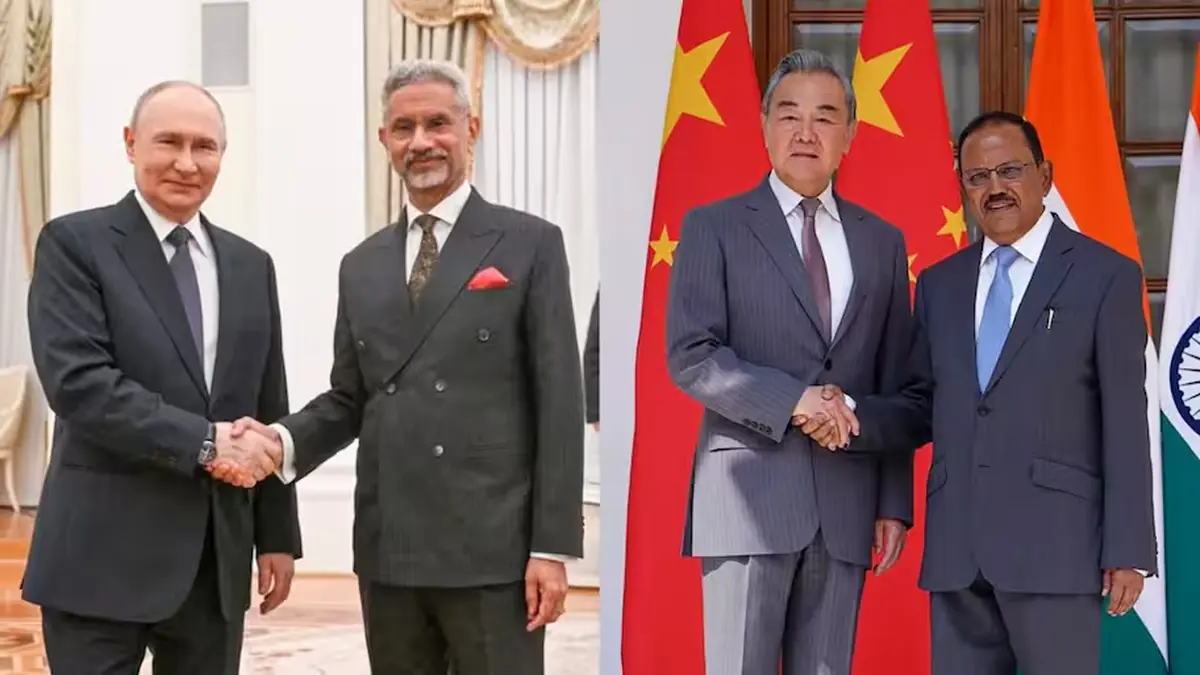
While Ajit Doval has been visiting Beijing in view of another test of India-China relations, he has come to China on an invitation from Chinese Foreign Minister Wang Yi on Monday for a two-day visit.
Meanwhile, India’s External Affairs Minister, S Jaishankar, has been visiting Moscow for three days in order to enhance the “time-tested” relations between India and Russia.
Two capitals, two superpowers, and one message—India is working hard at all its relationships together.
The immediate trigger for Doval's trip to Beijing has been the Line of Actual Control (LAC), which both sides have been trying to maintain the relative peacefulness following the military standoff in eastern Ladakh.
However, it is not taking place in a vacuum either. The visit to Beijing by Doval comes at a time when there is a convergence between energy shocks and increasing supply chain challenges alongside a more difficult geopolitical and economic environment for the bilateral relationship—from the conflict in West Asia and challenges in the Strait of Hormuz to a volatile energy market situation.
India's position remains unambiguous and unchanged. New Delhi's position is that normalization of ties has to go hand in hand with peace and tranquility along the LAC.
Before Doval embarked on his visit, Jaishankar himself laid down the tone for the way in which India views this entire relationship with China.
In an address delivered during the Economic Times World Leaders Forum in New Delhi on August 22, Jaishankar said: "I think we went through a particularly bad patch between the summer of 2020 and the autumn of 2024, and that was basically because of what happened in the border areas."
He made clear the logic behind the way in which India has approached this issue: "Ultimately, peace and quiet in the border areas is a prerequisite for good relations, and the condition of the border area, to a very great extent, will also determine the condition of relations."
There is a unique set of implications attached to the upcoming Russia visit of Jaishankar, which is related to the pressure that India is under by Washington.
This visit is made in the context of deteriorating relations between India and the United States following the increase in tariffs by President Trump on Indian products to 50%, including an extra tariff of 25% on buying Russian crude oil.
The formal program adds weight to the visit itself through giving it a formal structure, which includes co-chairing the 26th session of the India-Russia Inter-Governmental Commission on Trade, Economic, Scientific,Technological,l and Cultural Cooperation. There will also be a discussion of the recent efforts by the Trump Administration to achieve peace in Ukraine.
This particular occasion distinguishes itself from other diplomatic tours in that both of them were announced right from the outset as a part of a combined effort.
There have been reports that Doval had a planned tour to Moscow first this week, followed by Jaishankar towards the end of the month.
This is a visit that has been described as reinforcing India's strategic partnership with Russia even as there has been increasing pressure from US President Trump, who criticized India and Russia in strong terms last week, describing them as "dead economies."
The timing, however, was not accidental. Both these tours are scheduled just before President Putin is expected to visit India for the annual summit, in conjunction with the upcoming meeting of SCO leaders in China between August 31 and September 1.
Beyond the diplomatic discourse lies a highly pragmatic and urgent equation about energy security.
Doval is supposed to shed some light on the approach taken by New Delhi regarding its crude oil supplies from Russia as Moscow could possibly reduce its prices for Indian imports even further following the reduction of the oil price cap for Russian crude by the European Union in February, falling below the initial USD 60 ceiling that was announced by G7 countries back in December 2022.
In such conditions, for India, the new reduced cap means an opportunity to obtain crude at lower prices from Moscow, which is a clear incentive for India to continue fostering its energy relations with Russia in spite of the increased tariffs that are being put in place by Washington targeting these exact oil supplies.
There is an added dimension of significance for the China component of this effort due to future high-level meetings.
Prime Minister Narendra Modi will be in attendance at the Shanghai Cooperation Organisation summit in Bishkek, Kyrgyzstan, from August 31st to September 1st, and it is clear that the visit by Doval to Beijing comes prior to this summit and any potential meeting between Modi and Xi at this summit.
This follows on from a thaw in relations, fragile though it may be, between India and China, where Modi and Xi had their first face-to-face bilateral meeting in around five years at the BRICS Summit in Kazan.
Nor has Beijing sat idly by in the manner that it has packaged its engagement with India.
The Chinese had stated on August 12 that it saw the larger process of normalization with India as being headed in the right direction—an indication that the two capitals are at least committed, outwardly speaking, to not letting the present de-escalation path become stagnant.
Meanwhile, when Jaishankar visited Manila last month, he had highlighted the aspects of market access, trade imbalance, and certainty of supply chains to Wang Yi – thereby proving that even while the security situation along the border grabs the headlines, the economic irritants also figure high on India’s priority list with China.
It is not the first time that Doval and Jaishankar have played out this very scenario before, with one visiting Moscow or Beijing soon after the other, building on what the other has achieved. Previously, Jaishankar had visited Moscow expressly for the purpose of ensuring that the groundwork was laid for the Modi visit and the Annual Bilateral Summit between the two nations, shortly after Doval had visited Moscow and had met his Russian counterpart to discuss sovereignty and territorial integrity.
When viewed separately, both trips could be considered nothing more than regular diplomacy: one visit regarding border stability, while another serves as the co-chair of the US-India trade commission.
When viewed together, in light of US tariffs of 50%, an ongoing Russia-Ukraine conflict, and an increasingly stable but delicate relationship with China, this week’s combined trips seem to suggest a different narrative: that India is trying to maintain several major power relationships in precisely the moment when Washington has imposed the greatest economic pressure on New Delhi in recent years.
In light of the upcoming SCO summit in Bishkek and also Putin's trip to India that has yet to take place, the next couple of weeks will probably show how well the groundwork done by India during the course of the past week materializes in tangible results—a meeting between Modi and Xi, more details about discounted Russian oil, or LAC de-escalation.
From the perspective of Washington, watching India engage with both China and Russia at the same time, having to deal with 50% tariffs, speaks volumes by itself.