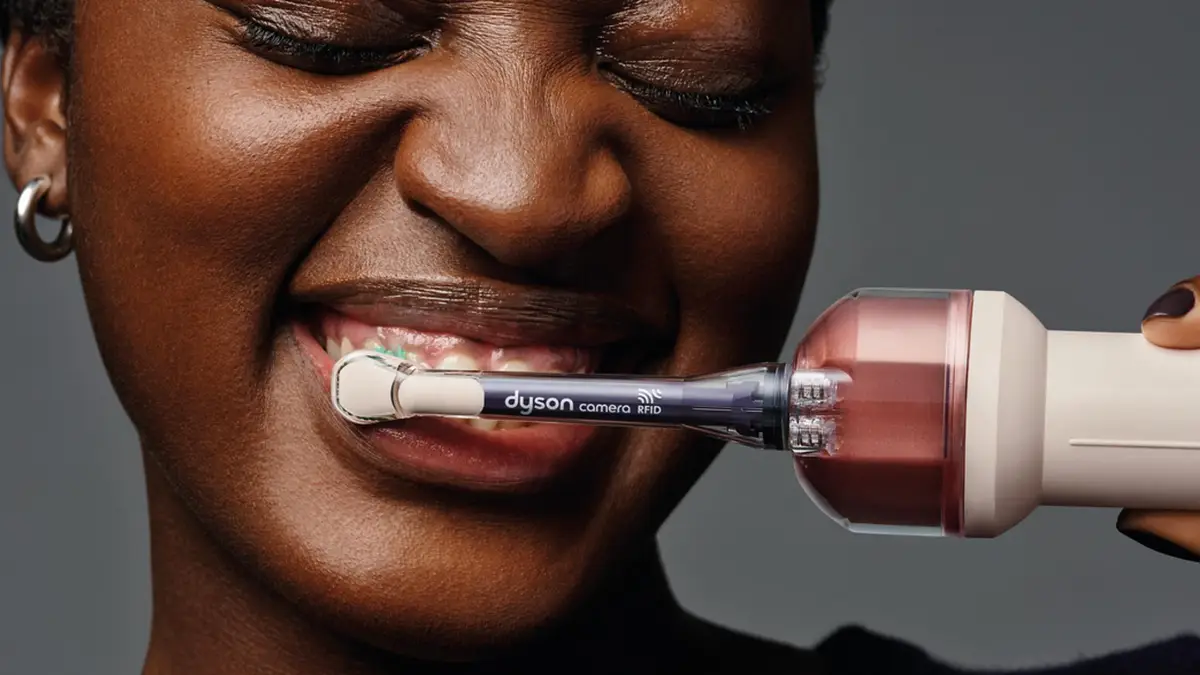
- Dyson's CameraJet launched September 1 at $499 (bundles run up to $568), with a UK price of £419.99
- A 1.2mm macro camera scans 28 images per second and fires a targeted mouthrinse jet at gaps between teeth within roughly 100 milliseconds
- Dyson says lab testing found the device removes close to 70% more plaque in hard-to-reach spots than premium electric toothbrushes
- It's the latest entry in a growing trend of everyday gadgets, from glasses to pendants, quietly getting cameras and AI stuffed inside them
There's a certain kind of confidence required to look at the humble toothbrush, a device that hasn't fundamentally changed since Oral-B strapped a motor to one decades ago, and decide it needs machine learning. Dyson has that confidence. On Tuesday the company unveiled the CameraJet, a $499 electric toothbrush with a built-in camera that watches your mouth in real time and squirts liquid at the spots you're missing.
Yes, a toothbrush that films your teeth while you brush them.
Strip away the marketing language and the CameraJet is three products fused into one housing: a sonic electric toothbrush, a miniature endoscope, and an automated water flosser. The camera itself is tiny, about the size of a pencil tip at 1.2 millimeters, but it's doing real work. Dyson says the 100,000-pixel macro lens captures 28 images every second, feeding them to an onboard algorithm the company calls Gap Optical Targeting. When that system spots a gap between teeth where plaque tends to build up, it triggers a precision jet of mouthrinse within about 100 milliseconds, no manual flossing required.
The brush head itself moves close to 1,000 times per second through sonic oscillation, with firmer bristles at the center for surface stains and softer ones along the edges for the gumline. Each head carries an RFID chip that quietly tracks how many cleaning cycles it's logged and nudges you when it's time to swap it out.
Everything routes through the MyDyson app over Bluetooth, which gives users a live, dentist's-eye view of their own mouth along with coverage maps and brushing feedback. Dyson has been careful to note that none of that footage leaves the device. Processing happens locally, and the company says images aren't stored or shared anywhere.
Getting a jet of liquid to fire at the right spot in a wet, moving, oddly shaped human mouth turns out to be a genuinely hard fluid dynamics problem, which is presumably why this took Dyson six years and, per the company, 661 engineers, 38 patents, and 16 million lines of code to solve. Part of that effort went into an "anti-gravity" tank design meant to keep the jet firing consistently no matter how the brush is angled, since a lot of teeth cleaning happens sideways or upside down toward the back of the mouth.
The other part went into figuring out what actually counts as clean. Dyson spent roughly five years working with the National University of Singapore's Faculty of Dentistry to develop a synthetic stand-in for real dental plaque, something researchers could measure precisely in lab conditions. Testing against that proxy plaque is where the company's headline claim comes from: nearly 70% more plaque removed in hard-to-reach areas compared with leading premium electric toothbrushes, under Dyson's own test conditions.
"Flossing is an awkward and time-consuming chore," founder James Dyson said in the company's announcement, framing the whole device as a workaround for a habit most people already admit they skip.
That framing matters, because Dyson isn't really pitching this at people who already have a solid oral care routine. Niamh Turney, the company's senior commercial manager, told Bloomberg ahead of launch that innovation in this category has mostly stayed shallow, chasing digital features and brushing statistics rather than solving anything structural. Dyson's bet is that a camera-guided jet can quietly replace the flossing step for people who've never managed to make it a habit, which by most dental surveys is a lot of people.
Smart toothbrushes aren't new, of course. Oral-B, Philips, Oclean, and newer entrants like Feno already sell connected brushes that track pressure, timing, and coverage through companion apps. What none of them have done, according to reviewers who've gotten early hands-on time with the CameraJet, is build in an actual internal camera. TechRadar called it a genuine departure from the category after testing it for a week, though whether that novelty translates into mainstream demand is a separate question. One industry study last year found more than 85% of consumers had never even heard of smart toothbrushes as a category, camera or no camera.
The CameraJet also fits a broader pattern for Dyson, a company that treats category expansion as a coin flip. Its washing machines flopped and were discontinued back in 2005, and its much-hyped electric car program was scrapped in 2019 before a single vehicle reached customers. But its bets on personal care have landed harder: the roughly $400 Supersonic hair dryer, launched in 2016, grew into a business large enough that hair-styling products made up 30% of Dyson's US sales by 2023, and its $100 HushJet Mini Cool fan has reportedly sold out repeatedly since debuting in April.
Whether a $499 toothbrush becomes the next Supersonic or the next washing machine is, for now, an open question sitting in preorder queues. The CameraJet is available now on dyson.com and in Dyson Demo Stores, with wider retail availability to follow and shipping expected within the first week of September.