A
1.5 kilometre road in the Chandoopur block of Hamirpur is now muddy and slushy because of the rainfall this year.
This is the only road for about 3,000 people who have access to schools, hospitals, and the world.
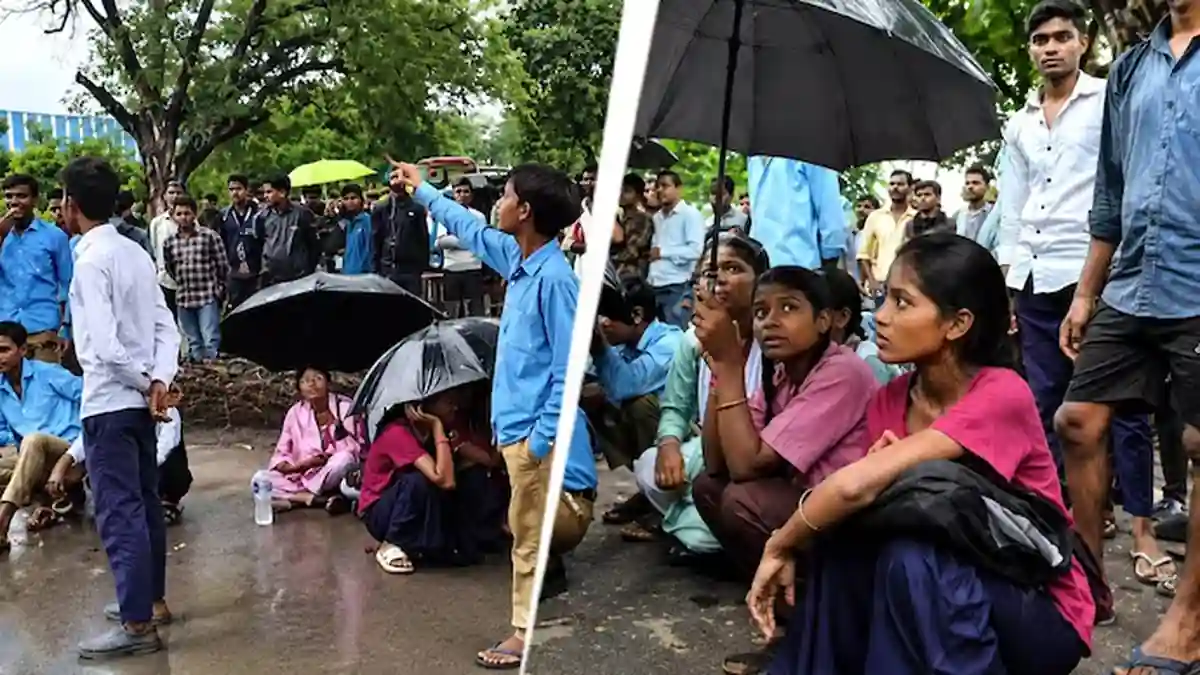
Students from Gen Alpha and local villagers protested against the bad state of this road in Hamirpur, Uttar Pradesh, and went directly to the district collectorate with their demand.
This was not a silent sit-in along the roadside.
Hundreds of students and residents of Chandoopur arrived at the collectorate office with the national flag in hand.
But the protests did not end there; the students attempted to storm the office of the District Magistrate himself.
That is when the tensions grew.
The policemen prevented the students from getting inside the DM’s chamber, thereby forcing them to stay at the entrance of the collectorate.
When the protesting children were marching toward the Collectorate, SDM Sadar Abhishek Kumar and CO Yashpal Singh, along with some police officers, tried to prevent them from proceeding any further.
But the children did not stop and instead blocked the main entrance of the Collectorate.
This is not about children going on strike against some abstract issue.
These children went on strike because of the state of a road measuring about 1.5 km long in the Yamuna belt that connects several villages.
It was alleged that the state of this road had deteriorated into mud and slush after the rains, which was hampering the journey of the villagers.
According to locals, the state of the road had caused difficulties to children in reaching schools and also in moving sick members to hospitals.
Where there was initially only a local dispute, it gained a lot of attention from all across the nation.
It gained a lot of attention from social media with the founder of CJP, Abhijeet Dipke posting a video and making a comment on Instagram which said, “This Independence Day, let us pledge to better the condition of Government Schools in our villages.”
On X, he took the matter one step further by applauding the children, saying, "Salute to these kids who are fighting for their future! All they want is a road to their school. Is it too much to ask in a country which is almost 80 years old now?”
Interestingly, the Hamirpur protest happened a day after Dipke himself had announced a nationwide campaign for the same cause.
Hamirpur is just one among many such incidents that are increasing day-by-day.
There have been five such instances in the state of Uttar Pradesh in the last twenty days, where the children have termed their actions as “Gen Alpha movement”.
The demands made by the children have included better facilities in education and other basic requirements as well as worries about drugs in their area and bad roads to reach their school.
In Lucknow, girls from the school named Jai Prakash Narayan Sarvodaya Vidyalaya walked up to 2.5 km in rains to reach an intersection and then sat in a circle on the road and stopped traffic, protesting against the shortage of teachers which was creating problems for their preparations for their boards.
In Pilibhit, students of Jawahar Navodaya Vidyalaya went on to the highways when their fourteen mobile phones were confiscated from them and they demanded laptops and Wi-Fi for their board exams preparation.
Not like most protests that go in vain, these protests are beginning to yield some quick and positive outcomes too.
For example, students from Hamirpur managed to get a road worth ₹1.81 crore built for their school after marching towards the collectorate.
In the district of Khatima of Uttrakhand, a protest by students demanding an end to dirty hostels and bad food resulted in the dismissal of the principal of the school.
Even the UP Social Welfare Minister Asim Arun got off his convoy to speak to the students who were protesting in Lucknow, and was reportedly satisfied after spending about two hours talking to the authorities of the school.
It’s not just the fury that makes all these protests similar; it’s the generation that won’t wait patiently for grown-ups to sort out the issues they’ve been complaining about for ages.
For many decades now, political parties have neglected the condition of infrastructure in schools because they believed that kids don’t have a right to vote and thus are unheard.
Gen Alpha, which is the name given to this latest protest wave, seems to be completely reversing the equation by employing viral videos and direct confrontation with the local administration.
The phenomenon is not confined to the state of Uttar Pradesh alone.
The children in the districts of Barmer and Jalore in Rajasthan have locked themselves inside their schools, sitting outside their gates demanding that the government fill up the teaching posts in the state, saying: “We are not begging for charity. We are demanding our basic rights.”
In Jharkhand, the students marched from the stadium to the town center saying that the state-level exams were not being conducted in a fair manner.
The students of Maharashtra have even started a citizen journalism movement of reporting road potholes while wearing their school uniforms.
For the villagers of Chandoopur, the most pertinent issue is how this assurance translates into a repaired road prior to the arrival of next year's monsoons.
In the larger context of the state government of Uttar Pradesh, five such instances in twenty days is a trend that is not going to end soon and requires a collective solution rather than a piecemeal one.