I
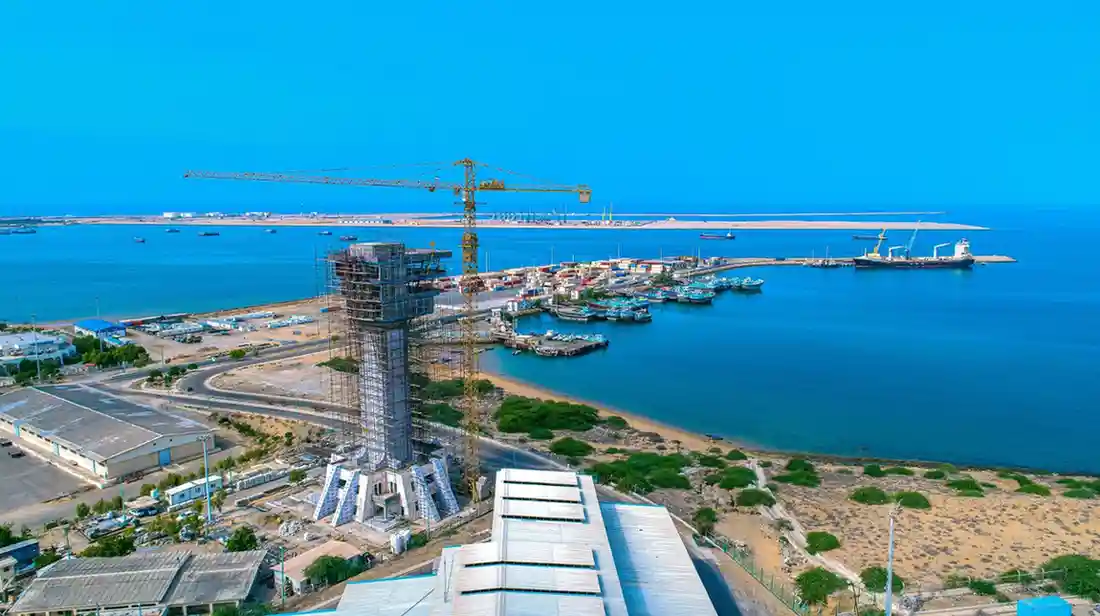
ndia and Iran have started negotiations regarding the temporary arrangement concerning Chabahar Port, which will help to keep functioning this strategic port until India gets the US lifting its sanctions which had expired earlier this year.
Chabahar Port, the crucial link of India towards Afghanistan and Central Asia, has embarked upon a new stage in its development. The US sanctions waiver regarding Chabahar Port expired on April 26, thus New Delhi is currently negotiating with Iran an interim plan for its functioning.
As per various reports citing The Economic Times, the two parties are exploring a new management mechanism in consultation with Iran's Ports and Maritime Organisation. The crux of the proposed scheme is simple: let an Iranian party have the operational control temporarily while securing India's interest in the port.
The most important point in such a framework, as per reports, would include a clause stating that the operational rights will be transferred back to India after the removal of sanctions restrictions on Chabahar Port.
Besides, New Delhi would like to obtain a legal commitment from Tehran that the temporary arrangement will be reversible in case US sanctions restrictions are lifted. It should be noted that India does have some experience with such interim arrangement – in 2018, a short-term management arrangement with Iran's company was made prior to India's management of the port Shahid Beheshti.
The recent crisis can be traced to September 2025, when the US withdrew Chabahar's sanction exemption of 2018 as a result of the Iran Freedom and Counter-Proliferation Act. The initial waiver recognized a humanitarian use and Afghanistan's reconstruction support as the key function of the port and allowed Indian companies to manage it without facing any restrictions.
Further, India obtained a conditional sanction waiver that would work six months from October 29, 2025 to April 26, 2026. Unfortunately, this new waiver was not extended after expiration of its period. Besides, in spite of the previously yearly allocations worth nearly Rs 100 crore to the project, in the Union Budget 2026 India did not allocate any funds.
To add even more difficulty, during this period there was a full-blown military conflict between the United States, Israel, and Iran going on. It is worthy of note, however, that India's Ministry of External Affairs reports that the terminal Chabahar suffered no damage as a result of the strikes.
In May 2024, India signed a ten-year agreement with Iran's Ports and Maritime Organisation for equipping and operating the Shahid Beheshti terminal out of Chabahar Port's two terminals (the other one being Shahid Kalantari).
India promised in the agreement a commitment of $120 million towards purchasing the port's equipment, a sum which the Indian External Affairs Minister, S Jaishankar, has reportedly described to Parliament as 'grant assistance'. India has further committed itself to provide a $250 million Line of Credit in rupee equivalent for developing port infrastructure.
However, for India, its strategic significance goes well beyond its utility as an avenue for commercial shipping. India gets from Chabahar an opportunity to secure the route which goes straight to Afghanistan and Central Asia through sea-land route and doesn't pass through Pakistan, which is a long time strategic objective for India.
The port is considered in India's strategic community a counterweight to China's port in Pakistan which is less than 140 kilometres away in Gwadar on the same coastline.
Any loss by India at Chabahar Port would not just be commercial but strategic too; it would lead to India giving up any position in contesting regional infrastructure in which China is making a rapid gain.
For Iran, meanwhile, Chabahar is the only Iranian port which provides access directly to the Indian Ocean thereby reducing its reliance on the Strait of Hormuz – a point of contention in its past conflicts with Western states. It is likely their mutual interest of strategic importance that keeps both parties at the table despite sanctions pressures, rather than the project collapsing.