F
inally, India has got its first bullet train project. MAHSR, which stands for Mumbai-Ahmedabad High Speed Rail corridor, is the most ambitious project that India is building. At its inception, the cost of the corridor was expected to be approximately ₹1.08 lakh crore. This will be a 508 km corridor which will bring the Shinkansen technology into India and change forever how people will travel between economic hubs.
It will connect Mumbai with Ahmedabad by going through 12 stations such as Thane, Virar, Boisar, Vapi, Surat, Bharuch, Vadodara, and Anand. The speed of the bullet train will be 320 km/h, and the journey will take about two hours from Mumbai to Ahmedabad.
However, the bullet train is not just about travel time. Mumbai, Surat, Vadodara and Ahmedabad are some of India's major industrial and economic centers. The fast connectivity may be useful to unite these centers into one economic zone and promote businesses, tourism and employment there.
The bullet train corridor is designed to serve as the first step towards the emergence of the Indian high-speed rail system. Engineers and workers get the experience in construction, signaling, tracks, tunnelling and rail safety technologies. The gained knowledge might come handy when developing other high-speed rail corridors in India.
Japan is contributing to this venture through providing the technology and money. This fast train technology is based on the Japanese Shinkansen technology, which is famous for its safety and reliability.
In addition, Japan provides most of the funds in the form of development assistance loan.The terms of the initial financial support provided about 81% of the project funds with a 50-year repayment period and a 15-year moratorium.
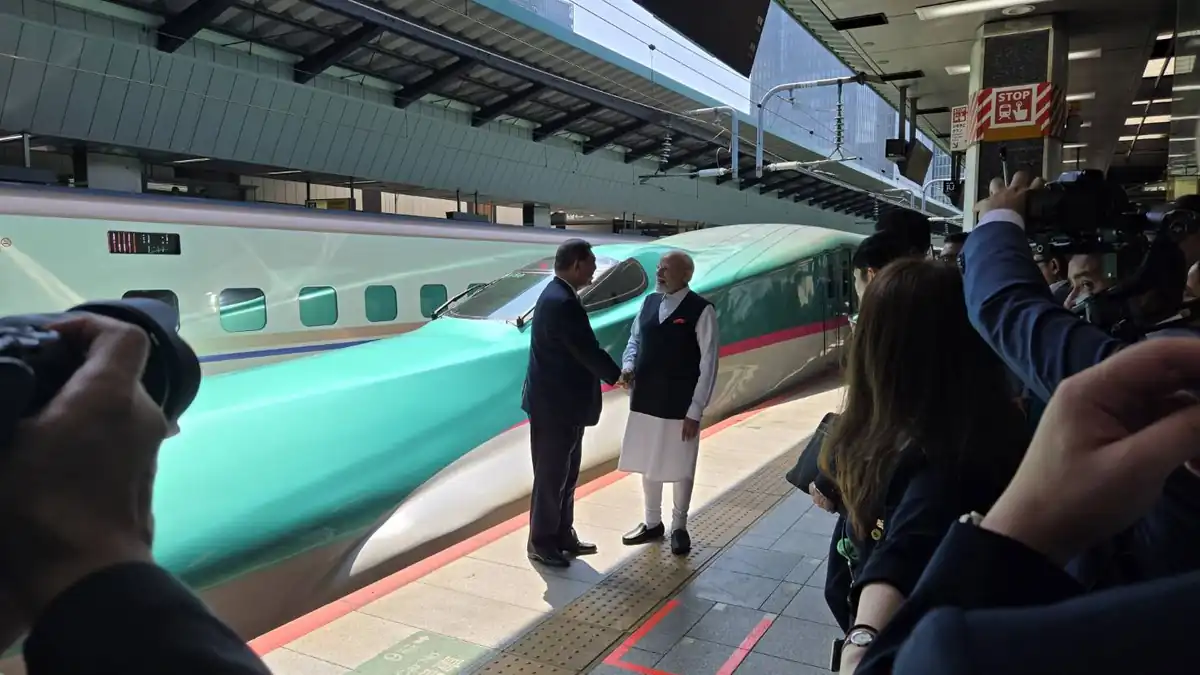
Photo: @shigeruishiba/X
The project was approved with the cost of ₹1.08 lakh crore. But delays in land acquisition and procurement caused huge cost escalations. According to recent reports, the total cost of the project might be about ₹2.1 lakh crore.
Thus, the bullet train corridor becomes an example of opportunities and risks associated with the infrastructure projects. Despite the high cost of the project, the government sees it as the foundation for further development of the high-speed rail network in India.
Ninety percent of the project is being developed on elevated viaducts, but apart from that, the project also includes tunnels, bridges, stations, signalling and electrification. Of particular importance is the section of the undersea tunnel underneath the Thane Creek.
In addition to employment opportunities, the project should enhance the capabilities of domestic production. Technology transfer and building Indian expertise are integral aspects of a wider objective.
The first high-speed rail is scheduled to start operating in August 2027, with the initial operational part running between Surat and Vapi. After that, the full length of the Mumbai-Ahmedabad corridor will come into operation.
Thus, India's bullet train project is not only a project of a high-speed train. This is a project aimed at creating the necessary technological, industrial and engineering capabilities in order to build the high-speed rail network in the future.
Consequently, the project worth ₹1 lakh crore has grown far beyond itself and has turned into a trial of India's ability to create, operate and develop a high-speed rail system of a world class level.