O
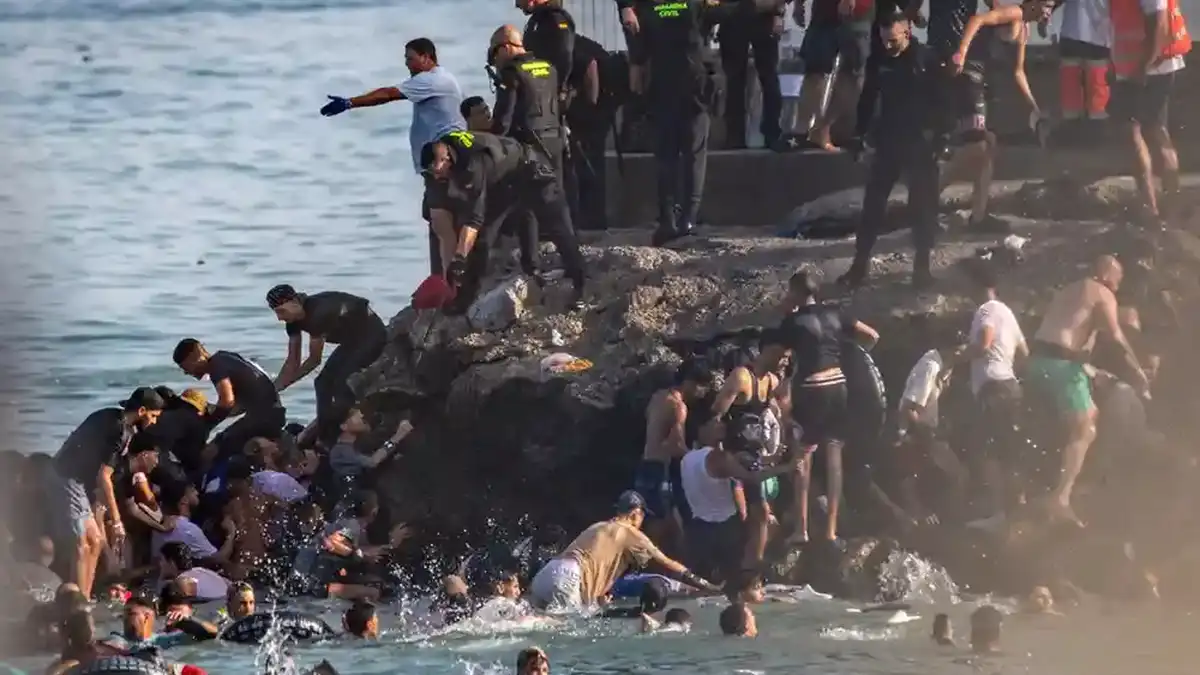
ne of the most significant border problems in the history of Spain is facing the country after 60,000 migrants entered the North African enclaved city of Ceuta from Morocco in the space of just 24 hours.
As many as 34 migrants lost their lives trying to cross, according to police sources, amid chaotic scenes on both sides of the border. The numbers were astonishing for a city with a population of about 83,000.
There emerged an instant increase in the number of people of Ceuta because of the massive number of people there. As per the Spanish government, it was becoming increasingly difficult for them to handle the situation since the reception centers were becoming overburdened.
The migrants entered both through the sea route as well as through the land route, with many crossing over through scaling the border wall or swimming around a wall that extended into the sea.
The most common way that the migration occurred was through the three-mile swim from the Moroccan city of Fnideq into Spain. Video footages at the border showed the migrants being hugged by the Spanish police officers on arrival. It can be seen that the police officers and the Civil Guards tried to make the migrants go towards the migrant camps. However, due to the large number of people, the process was becoming difficult for the authorities.
On the Moroccan side, the tear gas was used to make the crowds gathered on the hilltops near Ceuta disperse while others kept coming over through wading and swimming. By Friday, the situation started getting a little bit under control and it can be seen that many people were moving towards Morocco on their own.
The joint efforts of the Spanish and Moroccan authorities stopped the rush.
Prime Minister Sánchez arrived in Ceuta on Friday and addressed the media and local authorities. He referred to the situation mostly as a result of organized human trafficking rather than as a spontaneous immigration incident.
He noted that talks with Moroccan authorities made it clear that the traffickers took advantage of their interpretation of the most recent ruling of Spain’s Supreme Court, which spread among them rapidly in the few hours preceding the massive rush to begin.
Sánchez was rather critical of the human traffickers, saying that they were deceiving people, especially children, for the sake of profit. According to him, they are responsible for the victims who have lost their lives either at sea or on the border, as seen this week.
In addition, Sánchez referred to the mass intrusion as an insult to Spain’s territorial integrity.
The increase has been attributed to a Spanish Supreme Court ruling passed earlier in the month. The ruling denied officials the right to deport those migrants who entered Spain through sea without going through the due process but did not include those entering via land and scaling the fence. In the case of Sánchez, the traffickers have misread the law into a rumor which made the migrants believe that anyone entering Ceuta will be given an automatic pass to enter the country.
It is clear, according to him, that although there was something in this rule that may have triggered the rush to the border, the responsibility lies more on the smugglers for their misinterpretation of the ruling.
There are people who do not readily believe in the story that the court ruling was responsible for the influx of the migrants.
These activists from Morocco believe that it is unlikely that migrants coming from their countries will have any knowledge of this ruling from a court in Spain. What they want to emphasize here are the other factors that encourage such migration.
In this regard, the events in Ceuta sparked off an immediate response in Brussels. The president of the European Commission, Ursula von der Leyen, expressed her displeasure over the situation and noted that entry into the European Union should be done by following proper regulations.
Von der Leyen’s remarks indicate the overall concerns shared by EU member countries about the coordinated attempts to exert pressure on their external borders, especially considering that Spain is one of the main entry points into the European Union for African migrants.
France was not slow to react either. More specifically, the controls on the Spanish border have been stepped up, and the Rapid Border Intervention Force has been put into action to carry out additional checks.
The reason why Ceuta, together with its neighboring enclave Melilla, has always been a magnet for migrant flows is quite straightforward: the two territories constitute the only EU land borders with the African continent.
There have already been instances when migrants tried to break into the territories in huge numbers, some of which even resulted in deaths and deteriorated diplomatic relations between Madrid and Rabat.
However, this time the attempted migration took place on the background of growing friendly relations between the two countries, after resolving their diplomatic dispute, which had lasted for some time in the past.
The fact that the two states managed to improve relations generally implied that border control between them became stricter, which makes the current incident even more surprising.