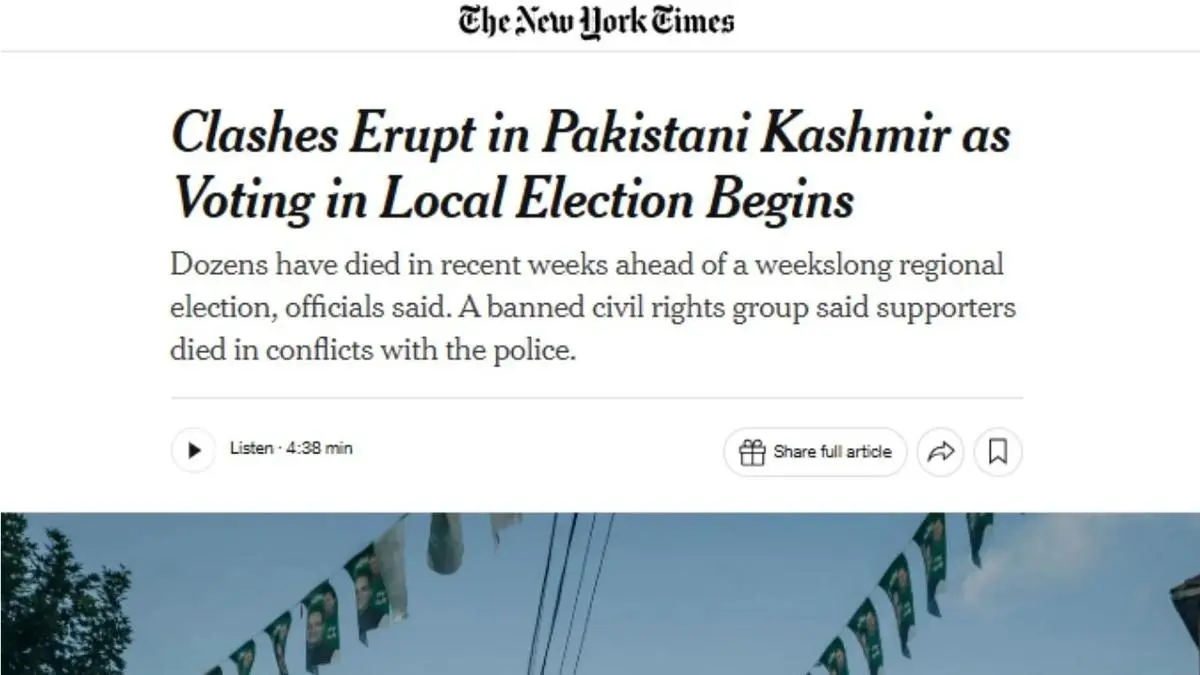
B
ut one such move made by one of the most reputed news papers in the world has brought about a strong diplomatic response from India. The Indian Embassy in the United States has found fault with The New York Times for using the expression "Pakistani Kashmir" to describe the Pakistan-occupied Kashmir (PoK) in an article recently published.
This diplomatic protest has been communicated through the microblogging site X from the official handle of India in the USA, which is that of the diplomatic mission. "Misleading and incorrect headline by @nytimes. There is no Pakistani Kashmir, only Pakistan occupied Kashmir," said the message from the Indian Embassy. It was the choice of one adjective, "Pakistani", instead of "Pakistan-occupied", which became the cause for protest.
As a comment to this news, the Indian embassy did not fail to not only make references to the title of the article but also once again stress the position of India concerning the issue.
Namely, it noted that "the Union Territories of Jammu & Kashmir and Ladakh have been, are, and will always remain an integral and inalienable part of India." "Pakistan is illegally occupying parts of these territories and employing violence against the occupied people." This position has been traditionally taken by the Indian government for many years, and it is consistent with its diplomatic approach, whereby the entire territory of the former princely state of Jammu and Kashmir, including those parts of it controlled by Pakistan at present, belongs to India.
This conflict occurs due to the publication of an article from the NY Times about the riots and the elections that have occurred in the Pakistan Occupied Kashmir. As per the report from the New York Times, there was a case of violent incidents in the city of Mirpur where there were clashes between the security forces and the Joint Awami Action Committee (JAAC), a civil rights group, who were demonstrating against the brutalities of the police.
The report further stated that at least two persons lost their life as a result of the gunshot.
There have been a series of riots for weeks, which have been causing interference with the election process.
There have also been allegations from the JAAC, stating that some members of the group have been killed in clashes with the police.
However, there have been news reports of the human rights organizations having been aware of the unrest in PoK. The Human Rights Commission of Pakistan has called for the immediate stop to the violence, as well as calling for a fair investigation into the death and injuries resulting from the violent events.
The call for a fair investigation indicates that the situation is extremely controversial not only from the viewpoint of Indo-Pakistan conflict over sovereignty, but also within the civil society of Pakistan.
The former Indian ambassador, Vidya Bhushan Soni, has provided additional information on the matter saying that the unrest is a result of years of frustration among the people of PoK over their ignored complaints.
However, for India, the issue between “Pakistani Kashmir” and “Pakistan-occupied Kashmir” is definitely not a small one. For Pakistan to claim its sovereignty in relation to “Pakistani Kashmir,” it would mean that there has been a valid transfer of the territory to Pakistan; but this is completely against the official position of India on the issue, where the region has not been legally transferred to any other country.
The use of language in the international media is, nevertheless, a very sensitive issue as it lies at the heart of one of the most contentious territorial disputes. While "Azad Kashmir" is what Pakistan calls the region – "Free Kashmir" – the word "Azad" is vehemently opposed by India.
It appears that the use by the NYT of the term "Pakistani Kashmir" is viewed by India as an acceptance of the Pakistani terminology.
It should be noted that this is not the first time that the government of India has come out against the reporting and framing of stories done by The New York Times. The Indian government has also in the past criticized other stories published by The New York Times but on unrelated subjects.
For example, in a case where the Indian government disputed a NYT report about an Indian company's link with a Russian organization, it was seen that the government considered it factually incorrect as well as an effort to misrepresent the facts to suit a particular version of events.
In any case, these instances are indicative of a growing trend whereby the Indian government has become more vocal and prompt in disputing international reporting on matters that it considers inaccurate or unfavorable.
These kinds of debates demonstrate the dilemma that exists between international journalism and unresolved geopolitical controversies.
For news organizations reporting about Kashmir, they have to always consider and balance various terminologies, which each imply certain political messages, while the governments involved in the conflict are extremely sensitive to how the reports about their claims appear in international media.
There are many reasons why India chooses to criticize any inaccuracy in the media quickly and in a public manner, among others, defending its position legally, warning other media organizations about the delicate nature of the subject matter, and making sure that its message prevails against the competition.