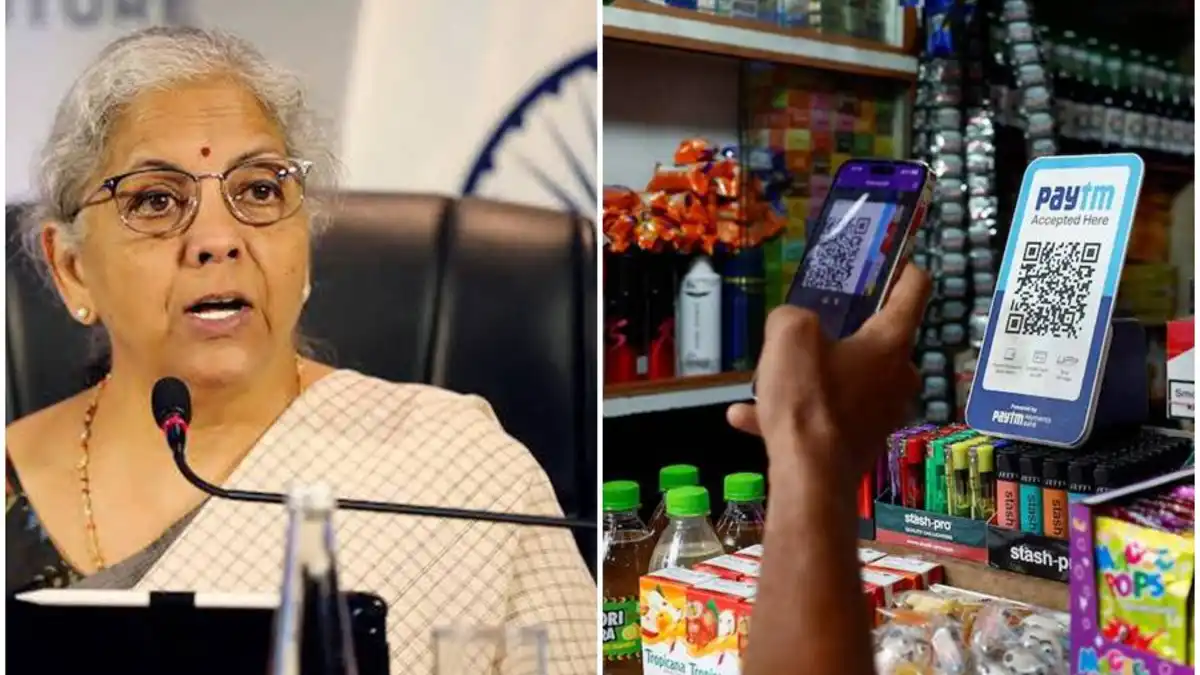
India’s finance ministry issued new regulations on Monday, September 14, 2026, that would enable the introduction of a Merchant Discount Rate (MDR) on all UPI transactions greater than ₹2,000 received by merchants.
The new regulations do not place any charge themselves. Rather, they leave the responsibility to decide that with the UPI and Services Steering Committee, which is led by NPCI (National Payments Corporation of India).
It appears that the steering committee is set to determine a rate of about 0.4%. The actual details, including the starting date and scope of implementation, are yet unknown.
From January 2020 onwards, MDR on transactions via UPI and RuPay debit cards has been nil as part of the government initiative to promote digital payments.
The notification issued on Monday ensures that the protection remains intact for UPI and RuPay debit card transactions that are up to Rs. 2,000. Beyond that point, however, the exemption is not automatic anymore, and there is room for charging a fee.
It should be noted that the notification only eliminates the legal impediment to charging MDR on transactions above Rs. 2,000 through UPI. The decision to actually charge a fee will have to come from NPCI’s board of governors.
The new fee will only be applicable to person-to-merchant (P2M) transactions where money is spent in the shop and not when transferring money from one individual to another.
Transferring money among family members (P2P) or splitting bills with friends regardless of the amount that is transacted would be exempt from any fee, as reported.
In addition, small merchants will also be exempt from any fee. It looks like the fee, if it comes, will only be applied to larger merchants, and smaller merchants who use the system for purchasing basic necessities like medicines or groceries would still not have to pay anything.
In the currently proposed structure of this fee, it is based on the merchant and not the consumer, and this has been common practice with card machines for a long time now.
The authorities say that the increasing cost of maintenance of UPI’s infrastructure is one reason for the decision. Over 55 crore users are using this system now, and it costs around ₹20,000 crore per annum to sustain this ecosystem, as per industry estimations.
The authorities have said that increased transaction volume, rising competition amongst payment systems, and sustainability in the long run are the reasons why the government decided to change its zero MDR policy on large transactions.
It has been claimed by some reports that this decision will earn the government between ₹5,000 and ₹10,000 crore annually, which can be divided among banks and other service providers, with a considerable amount going to the banks.
Although the Finance Ministry announced on Monday that the MDR could be imposed on UPI transactions, the Finance Minister has made it clear that it has not made any decision about introducing an MDR on UPI transactions.
As per news reports, the government has clarified that the issue will be taken up by the UPI and Services Steering Committee after the passage of the Taxation and Other Laws (Amendment) Bill, 2026, in Parliament. The bill itself does not introduce any fee but provides the government with the power to make a decision regarding the payment modes, which would continue to remain exempt from any fee.
It must be noted that to date, there has been no MDR levied on any UPI transaction.
A number of critical issues have not been resolved yet. There are doubts about whether the ₹2,000 limit would be applied to each transaction, each day, or each category of merchants. It is also not clear what kind of definition would be used to define a "large" merchant in relation to the exclusion for small merchants.
There are also issues regarding how the MDR income would be distributed among the issuing bank, the acquiring bank, and other parties such as payment platforms and payment aggregators.
The steering committee of NPCI, which consists of 22 people from the banking sector, payment companies, and other institutions, including the Payments Council of India and Indian Banks’ Association, is supposed to decide on the rate, merchant category affected, and the implementation date in the coming weeks.
Before then, the existing arrangement for zero MDR for transactions done via UPI not exceeding ₹2,000 will remain the same, and there is currently no fee being charged for any transaction amount.