T
he engineer-activist from Ladakh named Sonam Wangchuk who has gained popularity with his long-standing movement demanding the Sixth Schedule for Ladakh, was on an indefinite hunger strike since late June. By Saturday, he had completed 21 days without any food, striking in support of students facing paper leakages, growing expenses on education and student suicides in India.
In the morning of July 18, Delhi police officials entered the scene and forcibly took Wangchuk away from the protest site to Safdarjung hospital, stating that due to the poor health condition of the activist and already existing directions of the court, he needed to get medical assistance which he refused to do.
This happened two days before the march to Parliament, organized by the followers of Wangchuk in support of the cause of the campaign, which is linked to students' concerns.
According to visuals and eye-witnesses' accounts of the scene, there was resistance from other protesters, who were gathered around Jantar Mantar in support of the hunger strike of Wangchuk. This incident became the main political discussion topic for the day.
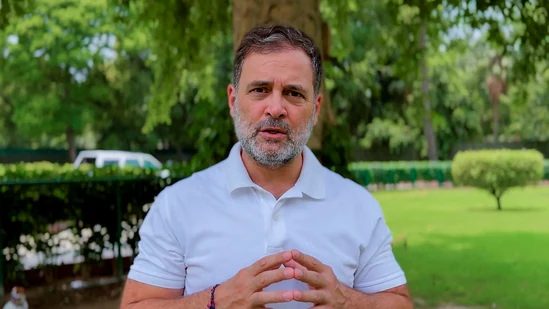
Breaking his long silence on the issue after remaining quiet for several weeks about Wangchuk's protest, Rahul Gandhi posted a message on social media platform X voicing his discontent.
Through an angry post, he claimed that the regime of the ruling establishment is characterized by two key features – deception and coercion, referring to the concepts of 'Asatya' (falsehood) and 'Hinsa' (violence) to illustrate what he perceives to be the basic nature of Modi government.
Gandhi said that removing Wangchuk from the place of the protest during his peaceful, non-violent fasting was an unjust exercise of state authority. He then linked this event to other problems that he raised lately, such as irregularities and leakage of examination papers, increased cost of education for Indian families, and rising cases of student suicides, which, according to him, are critical challenges for the country's future.
The Congress leader continued by stating that any exercise of state force will not stop India's students and their supporters from voicing their problems.
His statement was accompanied by a hashtag, #ChhatronKiGoonj, meaning 'Echo of Students,' which is used as a political tool to attract the attention of students regarding education-related problems.
But Gandhi is not the only personality who expressed his disapproval of the act done by the authorities.
Musicians and social commentators like Vishal Dadlani and actor and politician Prakash Raj have criticized the act through social media in strong terms that this was an act of cowardice on the part of the authorities. Groups from civil society that were involved in the protest have also condemned the act in strong terms, calling it a matter of national shame and brutality on the part of authorities that resulted in a peaceful protest being turned violent.
It was maintained by the supporters of Wangchuk that the protest organized at the Jantar Mantar had been peaceful and the fast of Wangchuk too had been a non-violent one.
The government representatives in support of the action by the police cited the deteriorating health condition of Wangchuk owing to lack of food for three weeks, emphasizing its medical nature instead of any political motive behind it.
Furthermore, officials referred to some prior orders issued by courts that had something to do with the management of protest/demonstration proceedings in the area. This was not the first incidence when plans of Wangchuk for protesting met with problems with the administration. Previously this year, Wangchuk, along with other protesters, faced refusal to conduct their sit-in protest at the very venue.
As a result, he had to move his fast to another place—Ladakh Bhawan in Delhi.
The previous incidence too received criticisms from the human rights activists since they viewed that the permission for conducting peaceful assembly at the historical place was granted inconsistently.
It is known that Jantar Mantar has been one of the few authorized places where protests can take place in Delhi, and any hindrance to the utilization of this place will automatically receive a lot of political attention.
The fact is that Wangchuk himself gained a reputation as a person who fights for the environment of Ladakh and constitutional rights and has already held several hunger strikes which turned out to be important events when it comes to joining local interests of Ladakh and civil rights and freedoms of speech at the nation-wide level.
It seems that by connecting this event with his own movement on the issue of students, Rahul Gandhi tries to emphasize the problem as a part of the government's approach to dissent, rather than to regard this case as an isolated case of law and order. As far as Wangchuk's supporters have decided to continue holding their protest march towards Parliament and the opposition starts voicing their position at the nation-wide level, it becomes obvious that this scandal is going to be alive for some time to come.