T
his announcement came on 20th August 2026 with this decision being yet another milestone in terms of development in Kashmir in recent years. USBRL project is an ambitious engineering project which has connected Kashmir valley to India's national rail network after decades of planning and implementation.
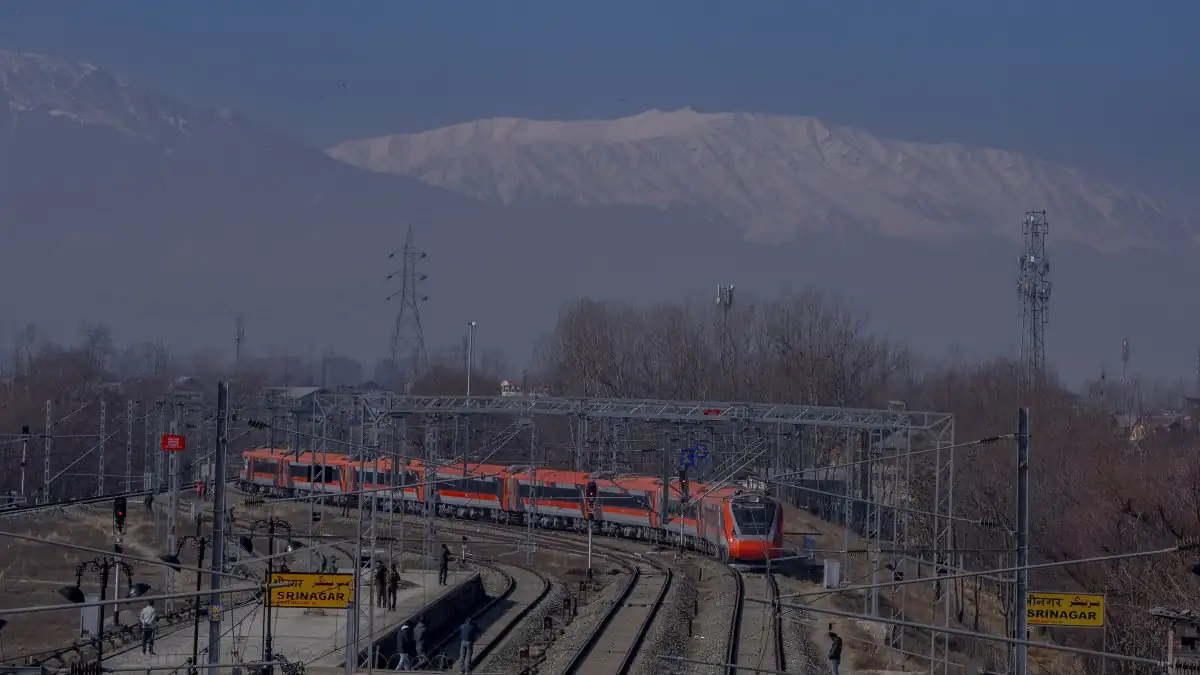
Trains can now run between 111km stretch between Shri Mata Vaishno Devi Katra and Banihal with a maximum permissible speed of 100kmph in this broad gauge line which will help reduce the journey time.
Until now, there was segmented speed restrictions on this line where the speed from Shri Mata Vaishno Devi Katra to Sangaldan could reach 85kmph and the speed for Sangaldan to Banihal would be 75kmph only but as per revised speed norms from the Jammu Railway Division of the Northern Railway now trains can run with a permissible speed of 100kmph in both stretches.
It should be noted that this has come after the Railways were fully convinced about all the safety parameters being in place before the decision to increase the permissible speed on this line since the section is not an easy one as this section cuts through Pir Panjal range.
Uchit Singhal Senior Divisional Commercial Manager of Jammu Railway Division said that with this move, it is possible to substantially save journey time of passengers traveling through Katra to Banihal to enter the Kashmir Valley.
No doubt, this development was best reflected through the image captured of a Vande Bharat express speeding at about 100km/hr through the Chenab Railway Bridge, which is the tallest railway bridge in the world.
With a height of about 359m above the Chenab riverbed, in the Reasi district, the rail bridge has been an iconic engineering marvel of the USBRL Project and an indicator of India's commitment to integrate Kashmir directly into the Indian Railways network.
The feat of viewing a train running at nearly full permissible speed on such a monumental project speaks volumes not only of the construction of the rail bridge, but of the assurance that has grown in the minds of the railways authority regarding its stability and security after various inspection drives conducted during the last several months.
While the Katra-Banihal section of the route may seem like any other railway project, it is actually an integral component of the USBRL Project, which was proposed by India's central government back in the 1980s as a way of integrating the Kashmiri territories into the Indian rail network.
Having endured many decades of delays and difficulties in terms of the adverse weather, potential earthquake risks, and difficult geography, the route is finally operational.
Not only will the corridor act as a significant political statement, it will also be of major economical importance as well. Improved railway connection is likely to facilitate easier movement of pilgrims who want to visit the Mata Vaishno Devi temple situated in Katra, boost economic activity in the Union Territory, and enhance the local tourism, as the rail corridor is much less prone to landslides and seasonal closures than the road connection.
Furthermore, for the people of the Kashmir Valley, the fast and efficient train connection with the rest of India becomes available year-round through this corridor.
The speed increase is a continuation of the development which has been going on for decades now. The project of the Jammu-Udhampur segment was launched back in 2005.
Then followed the phased development of local train services in the valley beginning from 2009. The direct train connectivity was provided to Katra in 2014. It is important to note that the hardest and most problematic part of the project was the segment between Katra and Banihal through Pir Panjal ranges.
It has become possible to conduct trial runs on this segment only in early 2025 when the Commissioner of Railway Safety (CRS) conducted numerous checks in order to give permission.
Since then the incremental testing and safety assurance have permitted the Railways to gradually increase the speed limit, resulting in this recent permit for raising the speed limit to a standard 100 kmph across the segment.