S
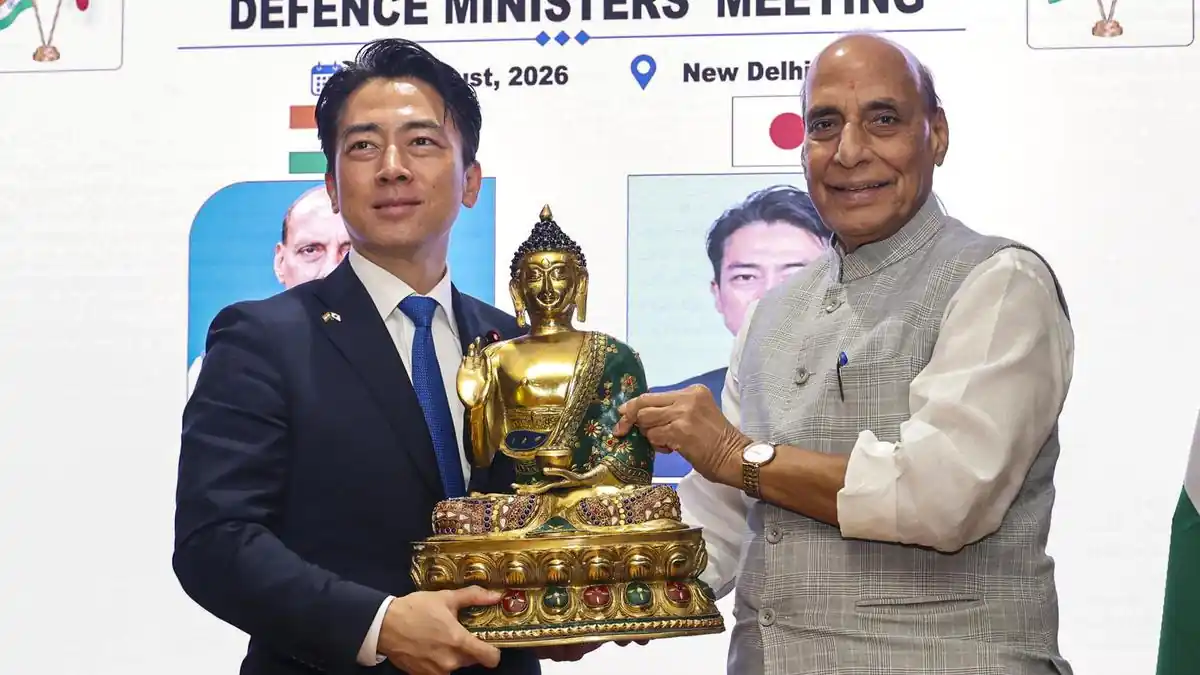
hinjiro Koizumi landed in Delhi this week on his first trip to India as Japan's Defence Minister. Two days later he was at the Manekshaw Centre shaking hands with Rajnath Singh, and by the end of that meeting the two countries had a maritime security pact signed, sealed, and already making headlines back in Tokyo and Beijing both.
Singh greeted him with a "Konichiwa, Koizumi San," which is the kind of small thing that gets mentioned in every wire report and probably means less than reporters make of it. What matters more is what came after. Koizumi told reporters that when the talks wrapped up, Singh put an arm around him and called it a fruitful meeting. Whether that's genuine warmth or just good diplomatic theatre, hard to say from outside the room. Probably a bit of both.
The main thing signed on Thursday was a Memorandum of Arrangement on Maritime Security Cooperation, between the Japan Maritime Self-Defense Force and the Indian Navy. In practice that means the two navies will share more on maritime domain awareness basically, who's watching what in the water and telling whom plus closer coordination on search and rescue, and disaster relief work.
Not the flashiest headline you'll read this year. But there's a detail worth sitting with: this is the first time the two countries have issued a standalone joint statement at just the defence minister level. Earlier statements came bundled into 2+2 dialogues or leader summits. This one stood alone. Officials on both sides seem to think that matters more than the text of the MoA itself.
There was also talk, still fairly loose, about building naval ships together and expanding tech and R&D cooperation under Make in India. Nobody signed anything on that front yet. It's the kind of thing that gets floated in a joint statement and then either quietly dies or turns into something real over the next two years. Too early to say which.
Now for the part that's actually got people talking. Japan is reportedly planning to send Air Self-Defense Force F-2 fighters to India next month, which would be the first time Japanese combat aircraft have ever touched down on Indian soil for a joint exercise. The two air forces trained together once before, back in 2023, but that was in Japan Veer Guardian, held at Hyakuri air base. This time it's India's turn to host.
Chinese state media didn't waste much time. Global Times ran a piece quoting a Japanese defence official who apparently linked the move directly to "countering China," which is not exactly subtle language for something Tokyo usually prefers to frame more carefully. India and Japan, for their part, kept the joint statement vaguer. They spoke of opposing unilateral actions that impede freedom of navigation and overflight, and rejecting any attempt to change the status quo by force or coercion. No mention of China by name anywhere in it. There rarely is.
One thing that didn't get as much play in the coverage: India reportedly asked Japan to be cautious about sharing advanced defence technology with Pakistan, citing Islamabad's growing ties with North Korea. It's a small aside compared to the maritime pact and the fighter jets, but it says something about what's actually on India's mind in these conversations. Not everything is about China. Sometimes it's about the neighbourhood too.
Singh also brought up the Kumamoto earthquake and reassured Koizumi that India stands ready to help where needed. Not a headline item, but the kind of line that tends to show up in these meetings regardless of what else is on the agenda.
This didn't come out of nowhere. Both sides pointed back to a Japan-India Joint Statement from July as the groundwork for this week's talks, and the two countries have been building toward this for a while now Quad partners alongside the US and Australia, over a decade of maritime cooperation, the odd civil nuclear negotiation thrown in along the way. What's different this time isn't the relationship itself so much as the pace of it. A standalone statement, a signed MoA, shipbuilding talk, and a first-of-its-kind jet deployment, all packed into one visit.
Singh has also been using the phrase "Mahasagar Vision" around this meeting, which suggests India wants this read less as a reaction to China and more as part of a bigger, ocean-focused strategy of its own. Whether that holds up is going to depend a lot less on what got signed this week and a lot more on whether any of it actually gets built.
Defence Minister Rajnath Singh and his Japanese counterpart Shinjiro Koizumi met in New Delhi on August 20, 2026, and signed a Memorandum of Arrangement on Maritime Security Cooperation covering maritime domain awareness, search and rescue, and disaster relief between the Japan Maritime Self-Defense Force and the Indian Navy. It marked the first standalone joint statement issued at the defence minister level between the two countries. They also discussed joint naval shipbuilding and defence technology cooperation, and Japan is expected to deploy F-2 fighter jets to India in September for the first time ever on Indian soil. Both sides opposed unilateral actions altering the Indo-Pacific status quo without naming China directly, while India separately raised concerns about Japanese defence technology reaching Pakistan given its ties with North Korea. Singh also offered continued Indian support to Japan following the Kumamoto earthquake.