S
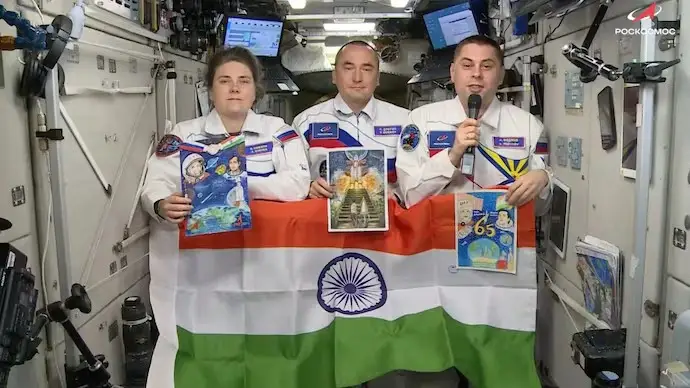
pecial greetings for the people of India from cosmonauts of the Russian group on the ISS were sent just before the celebrations of India's 80th Independence Day, hoisting the flag of India and stressing the long-lasting space cooperation between the two nations.
Speaking via audio-visual greetings posted on August 10, the three cosmonauts, Pyotr Dubrov, Anna Kikina, and Andrey Fedyaev, sent their greetings to India while speaking about the vast cooperation between Moscow and New Delhi, where space exploration has been a part of the cooperation process.
The cosmonaut, Pyotr Dubrov, started his greetings by congratulating India for its Independence Day celebrations, reminding that it was the 80th Independence Day of the Republic of India.
The cosmonauts were shown raising the tricolour while holding three posters of the past space cooperation between India and Russia.
It is important to mention that the Independence Day wishes of cosmonauts sent from the outer space have become a part of another historical event, as this year is marked by the 65th anniversary of the first ever flight in the outer space of the Soviet cosmonaut Yuri Gagarin in 2026. Besides, there was one more historical reference in connection with the Independence Day wishes sent by cosmonauts, as Gagarin visited India in November 1961.
Speaking about his famous statement about India, cosmonaut Anna Kikina said that "India looks beautiful from space, but it's even more beautiful and special since there are real friends here." Such an approach to the message made it possible to see the historical link between the visit of a cosmonaut of the Cold War era to India and the greeting from space, showing that there is continuity of six decades of diplomatic relations related to space in relation between these two countries despite the changes in the geopolitical background during these decades.
The cosmonauts took the opportunity to go over the long list of cooperation that has taken place between the two nations' space programs, describing this as one of the most enduring aspects of India-Russia relations.
They began with the year 1975, the time at which the Soviet Union launched Aryabhata, India's first satellite, thereby making it the official beginning of space cooperation between the two nations.
It would take close to a decade more, until 1984, for the first Indian to be in space, with Rakesh Sharma flying into space aboard the Soviet Soyuz T-11 spacecraft to the Salyut 7 space station, an event which has been remembered for a long time as a milestone for India.
According to Cosmonaut Anna Kikina, the partnership has entered a new phase now in view of India's Gaganyaan human space mission, which is its first such endeavor, and which has received a lot of help from the Russians.
An important part of the message sent by the cosmonauts is the allusion to the fact that India is preparing for its Gaganyaan mission, the preparation of which has been made possible by the use of Russian training facilities that were developed over many years of spaceflight experience.
The astronauts who have been chosen for the mission, which are also called Gaganyatris, have gone through the training program at the Yuri Gagarin Cosmonaut Training Center in Russia prior to the first Indian human spaceflight.
In fact, this cooperation is one of the more tangible examples of cooperation that the cosmonauts mentioned in the course of their general message.
Moreover, the fact that the astronauts for the Gaganyaan project are being trained at the facility where the cosmonauts from the USSR have been going through the training since the time of Gagarin is not accidental either because it symbolically links the Indian first space flight efforts to the heritage started by Gagarin, who also visited India in 1961.
In addition to the video message, the greetings also included mention of a collaborative competition initiated by Roscosmos, its India branch, and ISRO in order to celebrate the two countries’ partnership in space.
Winners of this competition were showcased along with the Independence Day greetings, thus lending another dimension to the tribute in addition to the messages delivered by the cosmonauts.
While specific information about the topic and participants of this competition is lacking in the reporting, one can assume that it was aimed at engaging the general public, possibly even school children or other young space enthusiasts, in marking this day rather than focusing strictly on delivering a message from space.
Such a dual strategy is quite typical of India-Russia space diplomacy where symbolic actions onboard the ISS are traditionally combined with similar activities on Earth.
The cosmonauts ended their video message with a straightforward message of goodwill, delivered in such a way as to ensure wide reception in India before the holiday period. In his concluding remarks, Russian cosmonaut Andrey Fedyaev held the Indian flag in the space station and said "Long live India-Russia friendship."
This final remark together with the image of the Indian tricolour waving in the microgravity of the space station made the greatest impact of the entire message as India celebrated its 80th anniversary of independence on 15 August.
The gesture is part of a trend for Russian cosmonauts to recognize India's national holidays from space, indicating a soft diplomacy aspect of the space collaboration apart from the technical cooperation on training and satellite launches as well as Gaganyaan project.