I
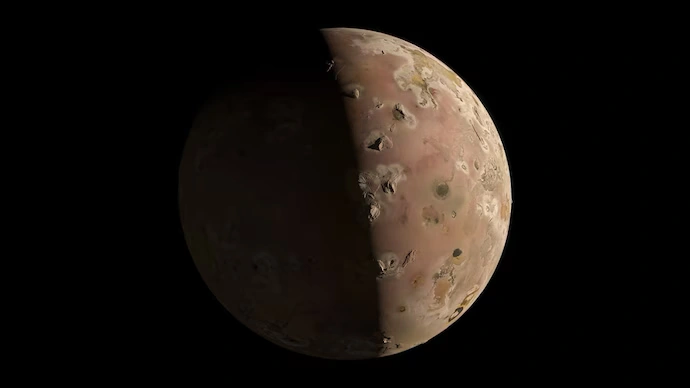
o doesn't really have secrets. Not visually, anyway. We've been staring at this thing since Voyager flew by in 1979. Over 400 active volcanoes, the most of anywhere in the solar system, lava lakes big enough to swallow small countries, all of it happening in plain sight where every telescope and orbiter could see.
What nobody had ever measured was what's going on a few feet under all that.
This week, that changed. NASA says Juno managed the first direct reading of temperature beneath Io's crust. And the instrument responsible for it? Wasn't designed with Io in mind. Wasn't even really designed for a moon.
Scott Bolton built the Microwave Radiometer, or MWR, years ago as a way to peer through Jupiter's cloud tops. He's the mission's principal investigator, based out of the Southwest Research Institute in San Antonio. Six antennas, six different wavelengths, all pointed at reading conditions deep inside a gas giant's atmosphere. That was the whole plan.
Then Juno kept flying past its original mission end date, the way spacecraft sometimes do when they're still working fine and nobody wants to shut them off. Its orbit started drifting toward three of Jupiter's biggest moons instead: Ganymede, Europa, and Io. At the first two, the MWR dug tens of miles into what everyone assumed were mostly clean ice shells. Fine, sure, ice makes sense.
Io is rock. Rock is supposed to be opaque to this kind of instrument past a certain depth. Somebody probably figured they'd get a shrug of a result and move on.
They didn't.
Two flybys made it happen December 30, 2023, and again on February 3, 2024. Juno came within roughly 930 miles of Io on each pass, aimed the MWR down, and recorded. The results landed this week in the Journal of Geophysical Research: Planets.
Shannon Brown, who led the study at NASA's Jet Propulsion Laboratory, said the readings covered everything from a few inches under the surface to tens of feet down. And at basically every spot they checked, temperature rose more than 40 degrees Fahrenheit within just a few feet. Sunlight can't do that. Whatever's driving that jump is coming from inside the moon, not above it.
Average that out across all of Io and you land somewhere between 1 and 3 watts per square meter of background heat. Bolton's way of putting it: think of a small nightlight glowing under every patch of ground the size of a card table. Sounds tiny until you remember it's happening across an entire world at once at which point it's close to 30 times what Earth gives off on average.
Two theories, and the paper isn't picking sides.
Maybe it's just conduction. Jupiter's gravity stretches and squeezes Io as it moves along its slightly off-center orbit, and that friction has to bleed off somewhere, slowly, through the crust. This is basically the same mechanism already blamed for the volcanoes in the first place.
Or maybe it's buried lava, still cooling. About 10% of Io's surface is actively flowing at any given moment, and some of it may sit trapped under 30 to 35 feet of hardened rock, losing heat over years instead of hours.
Honestly? Probably both, in different places.
Here's the part that wasn't even the point of the study. Away from the calderas and the mountains, big chunks of Io are just... flat. Smooth plains running 60 miles across in some spots. Juno happened to cross some of that same ground from different angles across its two passes, which let researchers see how the surface scattered the microwaves a bit like the way sunlight only flashes off ocean water from certain angles out of a plane window.
Brown said it looked more like the Great Plains than anything volcanic. Weirder still, that material is unusually light for rock. Closer in density to pumice, or packed ash, than to actual stone.
Tidal heating isn't unique to Io. It's the leading theory for how moons like Europa and Enceladus keep liquid oceans sloshing around under miles of ice, which is a big reason NASA cares about them at all. Up until now, scientists could only measure that kind of heat after it had already escaped through the surface. Now there's a way to catch it earlier, underground, before it ever gets out.
Bolton's even talked about pointing an MWR-style instrument at a volcano on Earth, just to see if a similar underground signature shows up here. If it does, that's a new way to watch heat move through rock long before anyone sees a drop of lava.