R
ecent observations from NASA's James Webb Space Telescope have provided new information about an immense cataclysmic event that transformed the moon family of the planet Neptune billions of years ago.
Three small inner moons of Neptune named Proteus, Larissa, and Galatea, as well as its inner ring system, have been studied, and clay minerals that form under the interaction of water and rock on the planets have been found.
The finding is unique because for the first time, scientists have managed to observe the chemical composition of icy bodies located far away from the Sun, obtaining evidence that was not purely theoretical.
The results obtained by planetary scientist Ryleigh Davis of the University of California, San Diego, were published in the journal Science Advances. It is believed that the present moon family of Neptune is not the primordial remnant but rather is a reconstituted one after an ancient impact event.
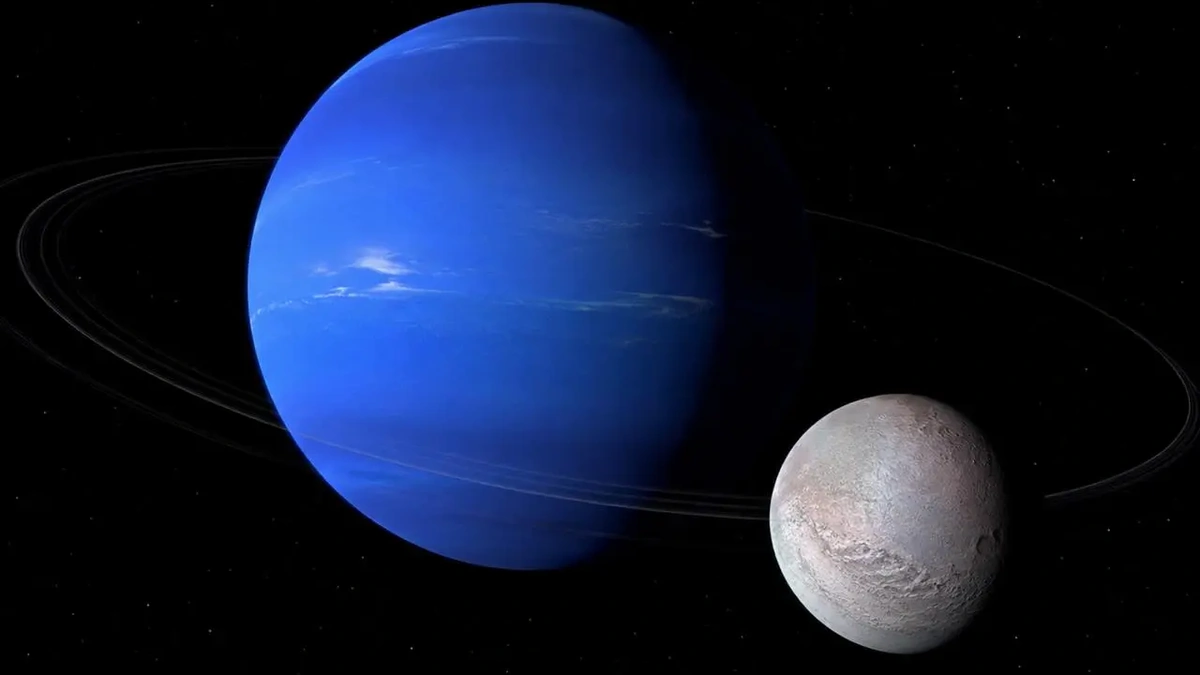
Triton, the biggest satellite of Neptune, is mentioned to be the one responsible for this disastrous occurrence in the past. Unlike other large satellites in the solar system, Triton's origin is very different.
This moon didn't develop along with its mother planet. Instead, it was born somewhere in the Kuiper Belt, a region of objects that includes Pluto and is situated further than the orbit of Neptune.
Triton was pulled into the gravity of Neptune within the first billion years since the formation of the solar system 4.5 billion years ago. This period is marked by the migration of planets from their original orbits to the present-day orbits.
Triton is bigger than Pluto but smaller than our Moon. The arrival of such a large celestial body in Neptune's gravity could have definitely led to some turmoil among Neptune's moons.
As Triton was captured in orbit around Neptune, the gravitational force exerted by this satellite disrupted the current moons in such a way that they began colliding with each other in a celestial version of a demolition derby.
As a result, it can be assumed that the previous moons were broken up into countless pieces of debris consisting of rock and ice. These pieces were not thrown out of the solar system but remained in the vicinity of Neptune, ultimately forming the small moons and rings currently seen in the solar system.
The fact that the moons of Neptune are significantly different from the ones found in the solar systems of Jupiter, Saturn, and Uranus, where several big moons can be observed, has finally been explained thanks to the latest findings.
While the other three planets feature several big moons orbiting them, Neptune features only one large captured moon with many small ones circling around it.
The crux of the finding is the particular types of minerals found by Webb on the surface of Proteus, Larissa, and Galatea.
Scientists found clay minerals rich in magnesium, which are believed to be formed on the dwarf planet Ceres located in the asteroid belt as well as in some meteors.
As suggested by Davis, such minerals usually take time to form during long interactions between water and rocks, but such conditions usually occur within large ice planets beneath their thick layers of ice, being invisible in any way.
Therefore, the finding of these minerals on the surface of outer Neptunian moons implies that the destruction took place in such a way that it basically turned large ice planets inside out and exposed their previously buried materials.
Davis suggested that the inner moons of Neptune might be the only place in the solar system where one can study these materials.
The theory of capture is further corroborated by an interesting fact about the satellite itself: it is the only big moon in the solar system that revolves around its planet in the opposite direction of its rotation, or what is called a retrograde orbit.
Moons that have formed along with their planet tend to follow the rotational direction of the latter since they have both formed from the same disc of matter. Triton's reverse orbit makes it quite clear that it must be something that came from somewhere else rather than forming alongside Neptune.
This particular trait has baffled scientists for many years, and the newly found chemical signature from the Webb telescope provides the missing link between the two different pieces of evidence.
Apart from finally providing an answer to one of the mysteries of Neptune’s history, this finding opens the door to new questions about how the scientists view the turbulent past of our solar system beyond Mars.
It highlights the notion that planetary systems, contrary to popular belief, do not simply form and stay unchanged throughout their lifetime, but keep evolving through dramatic gravitational collisions for many years after their creation.
Moreover, it proves that scientists have managed to develop tools that can reveal internal composition of even very faint and distant celestial bodies thanks to Webb telescope’s incredible capabilities that have allowed researchers to break down the reflected light into wavelengths and reveal specific chemical fingerprints in the atmosphere of Triton.