I
t hit before most of Tokyo had its coffee on. A magnitude 5.9 earthquake tore through the Kanto region early Sunday, centered in southern Ibaraki Prefecture, and by the time officials finished counting, at least 37 people across five prefectures needed medical attention. No deaths. Small mercy, considering the month Japan's had.
Depth was somewhere between 68 and 70 kilometers, according to the Japan Meteorological Agency, deep enough that the shaking spread out instead of slamming one neighborhood. USGS put the magnitude a hair lower, at 5.8. None of that matters much to whoever got tossed out of bed in Adachi Ward around dawn.
Adachi took it hardest inside Tokyo itself, hitting lower 5 on the shindo scale, the level where objects start sliding off shelves and you grab the nearest wall without thinking. Parts of Ibaraki, Saitama and Chiba felt the same. Elsewhere in the capital, plus Tochigi, Gunma, Kanagawa, it landed a notch softer, level 4. Soft is relative. It still woke people up fast.
Tokyo: 15 injuries. Saitama: nine. Kanagawa: eight. Chiba: four. Ibaraki, the prefecture where the whole thing started, just one. Thirty-seven total, and almost none of it came from falling debris or cracked walls. People were asleep. The floor moved and they fell out of bed, tripped on a nightstand, walked face-first into a doorframe in the dark. Mundane household objects turned dangerous for about ninety seconds, then went back to being furniture.
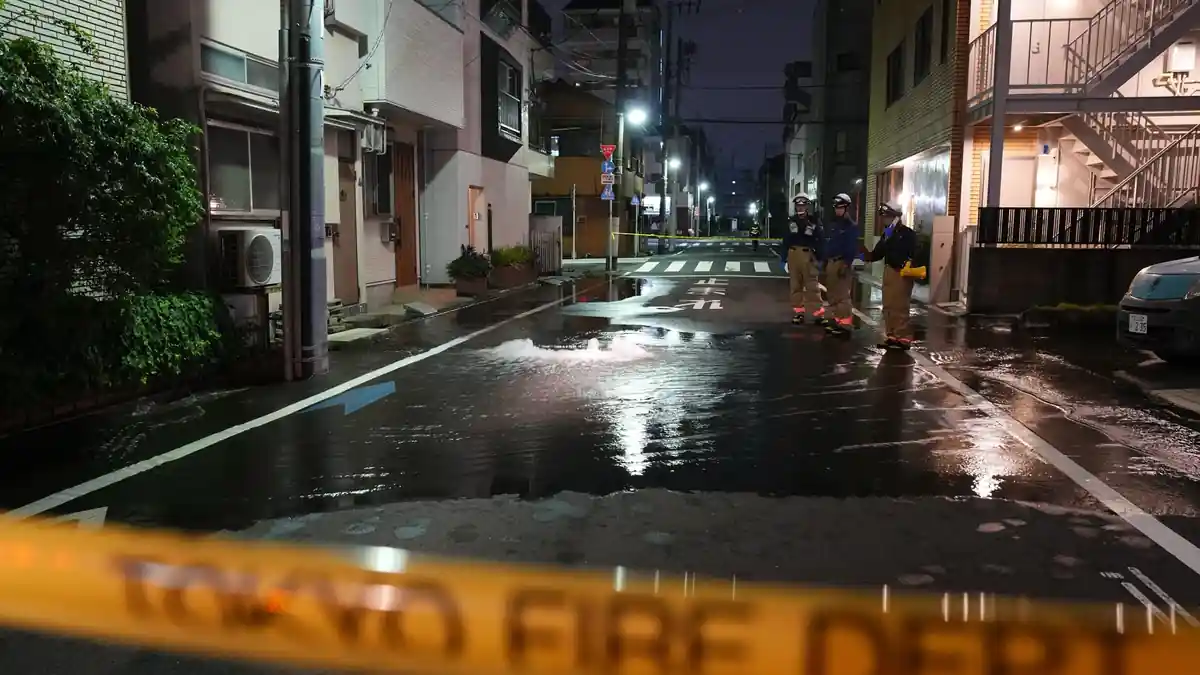
A water main burst somewhere in Tokyo, sent water pouring down a street. A few buildings locked their elevators automatically, standard protocol here, though it still leaves people stuck wondering how long the wait will be. Train lines paused for inspection, resumed within hours. Nuclear facilities in the region reported nothing unusual, a line Japanese officials check and repeat after basically every quake this size, almost out of habit at this point.
No tsunami warning. Probably the single biggest reason Sunday didn't turn into a bigger story.
Residents across Kanto have been told to stay alert for roughly a week. Shaking of similar or greater strength could still follow, the Meteorological Agency warned, and that's not the usual boilerplate caution stapled onto every quake bulletin. Aftershock sequences in this part of Japan don't always behave, and officials here would rather look overly careful than get caught twice.
People are paying attention, too, because it's been barely four weeks since Kumamoto. A magnitude 7.1 earthquake hit there on July 28, killed 38 people, some in a mall explosion, some when a factory chimney collapsed, and left tens of thousands without homes through the middle of summer heat. What happened Sunday doesn't come close to that in scale. But scale doesn't erase memory, not when rescue crews were pulling people from rubble less than a month ago.
Japan straddles the junction of four tectonic plates, part of why a moderate quake barely makes news here most weeks. Seismologists have called greater Tokyo, home to something like 37 million people, overdue for a major event for years. Every tremor drags that conversation back up, even one this mild.
Hospitals across the five prefectures are reporting mostly minor injuries. No major structural damage has turned up so far, and the fire and disaster agency says its response held up as designed. The advisory runs through roughly next weekend. After that, officials say they'll reassess.